


Ceiling fans are an excellent solution for maintaining a pleasant environment at any time of the year. However, when selecting and installing a fan, it is common for various questions and doubts to arise about its operation and features.
In this article, we will address some of the most frequently asked questions we receive about ceiling fans, providing clear and concise answers to help you make informed decisions and resolve any issues you may encounter.
1. What are the differences between an AC motor and a DC motor?
Ceiling fans can operate with an AC motor (alternating current) or a DC motor (direct current). They differ mainly in their efficiency and operation.
AC motors are more common and use alternating current to operate, being robust but less energy-efficient. In contrast, DC motors operate with direct current, are lighter, quieter, and allow for more precise speed control, in addition to being more efficient in terms of energy consumption.
The advantages of DC motors include:
- up to 70% energy savings
- less noise during operation
- greater durability
- ability to offer more speeds
These motors also allow the use of the reverse function, useful for redistributing heat in winter, and are notable for their speed in reaching the desired speed, offering optimal comfort at home.
Additionally, DC motors have a lower weight than AC motors, allowing fans to be installed on plasterboard ceilings. Always keep in mind the installation instructions, which you can find below.
2. What is the reverse mode?
The reverse function or mode is simply a switch that allows the fan to turn in one direction or the other.
In summer, the fan should rotate counterclockwise to generate a breeze downward.
In winter, the fan blades should rotate clockwise, so the fan pushes the air upward and forces the recirculation of warm air trapped at the ceiling. This function helps improve the efficiency of heating systems and maintain a comfortable temperature throughout the year.
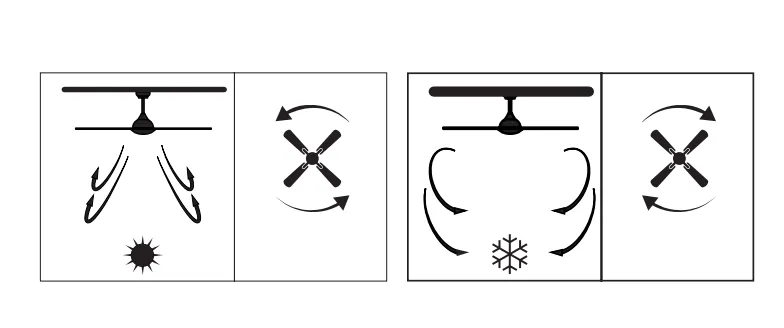
Using the reverse function offers several benefits, especially in winter. It helps reduce energy consumption by improving the circulation of warm air, which can decrease the need to use heating intensively. Additionally, it facilitates more uniform thermal comfort, eliminating layers of cold and warm air in the room. This feature makes fans a versatile and efficient solution for maintaining a pleasant environment at any time of the year.
3. How do I choose the fan based on the size of the room?
Indoor fans can be used in all rooms of the house, so it is essential to consider the size of the space when installing one.
- Extra large rooms (more than 28 m²): The diameter should be equal to or greater than 165 cm.
- Large rooms (17.6 - 28 m²): The diameter should be equal to or greater than 132 cm.
- Medium rooms (13 - 17.6 m²): The diameter should be between 107 and 132 cm.
- Small rooms (less than 13 m²): The diameter should be equal to or less than 107 cm.

4. At what height should I install the fan?
To ensure safety, it is recommended that the minimum distance between the blades of a ceiling fan and the floor be at least 2.30 meters. The ideal maximum ceiling height for a standard fan is 2.70 meters. If the ceiling is higher, it is advisable to choose fan models that allow the rod to be changed for a longer one, ensuring optimal and safe operation of the fan.
It is necessary to take into account the lateral distances. The minimum distance between the fan blade and the wall should be 60 centimeters. Additionally, make sure that the blades do not touch the ceiling if it is inclined.
In the case of installations on a false ceiling or plasterboard, these must be able to support at least 4 times the weight of the fan. This is because the load of the fan in motion is greater than that of the fan at rest.

5. How should I install a fan on a sloped ceiling?
In the case of a sloped ceiling, it is important to ensure that the fan is sufficiently far from the ceiling so that the blades do not touch it, thus ensuring safe and efficient operation. Additionally, the maximum allowable slope angle for the installation of a fan is specified in the instructions for the chosen model.
If the chosen fan does not support the slope angle of the ceiling, for example, a ceiling with a slope angle greater than 20%, it is possible to resort to other installation alternatives, such as using a platform or wedge that allows the slope angle to be reduced. You can read more information about this type of installation here.

6. Can I install any fan outdoors?
To ensure their correct operation and durability, it is crucial that these fans have a Protection Index (IP) of at least 44, ensuring their resistance to the ingress of dust and water. Additionally, it is important that the fan be installed at a minimum height of 2.30 meters in passage areas and 2.20 meters in areas with tables or sofas.
The maintenance of outdoor ceiling fans is similar to that of indoor models, including cleaning with a damp cloth and periodic checking of fixings.
Our current outdoor models are Typhoon, Winche (only the brown option), Sioux, Palma, and Marine.
7. How do I maintain a ceiling fan?
To keep a ceiling fan in good condition, follow these steps:
- Cleaning: Use a soft cloth to clean dust and stains. Avoid water to prevent damage to the motor and short circuits.
- Check connections: Ensure that electrical connections are firm and make adjustments if necessary.
- Tighten screws: Check and tighten all screws, paying special attention to the blades and their supports.
- Secure the mount: Check the mounting of the fan to the ceiling and adjust it to ensure a secure attachment.
- Blade alignment: Ensure that all blades have the same alignment to avoid abnormal vibrations.
These steps will help you prepare your fan for intensive use during high temperatures.
8. Can I synchronize a large number of fans?
Yes, it is possible. At Faro Barcelona, we have designed a gateway capable of synchronizing up to 128 units of smart fans, allowing control of both the speed and the light of the fans: Faro Fan Gateway 0-10/1-10V, with reference 34162.
This unique device on the market designed by Faro Barcelona allows integrating our Smart fans into home automation systems. Compatible fans carry the WP reference and must use the 34160 receiver.
If you need help with this type of synchronization, you can contact [email protected].
9. What is the warranty for ceiling fans?
Faro Barcelona is committed to the continuous satisfaction of its customers through a robust after-sales service. Our fans come with a 3-year warranty and, in the case of the fan motors, up to 15 years.
Additionally, we offer spare parts for most components of our fans, allowing them to have a longer lifespan.
To inquire about the possibility of purchasing a spare part, you can consult our sales team, as it depends on the fan model.
10. Where can I buy your fans?
You can buy our fans through our distributors, either physical or online, or in our showrooms.