

Preparing the first coffee of the morning, organising the grocery shopping or sharing dinner at the end of the day. The kitchen is one of the most frequently used spaces in the home and, increasingly, a central element in residential and contract projects.
For this reason, kitchen lighting requires precise planning that combines functionality, visual comfort and aesthetic coherence. A well-designed lighting scheme improves safety, optimises energy consumption and enhances the overall spatial experience.
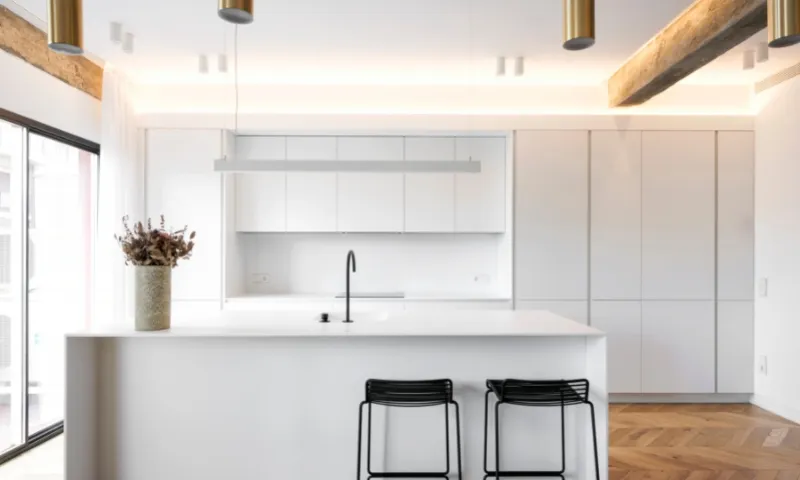
Paseo de la Castellana Project by Romero&Montoya | Recessed luminaire SVEN
Areas to be lit in the kitchen
In any kitchen lighting project, three clearly defined areas coexist:
- Work area
- Storage area
- Dining / office area
Each of these areas requires a specific lighting solution. However, general kitchen lighting must provide a homogeneous overall view, avoiding shadows and poorly lit zones.
A well-planned general lighting scheme improves task safety, optimises electrical consumption and helps create a balanced and functional environment.
General lighting in kitchens
The most common solutions for general kitchen lighting are:
- Recessed luminaires or downlights
- Surface-mounted luminaires
The key is to distribute several light points evenly across the ceiling. A minimum distance of 70 cm between luminaires is recommended to achieve uniform lighting.
From a technical standpoint, luminaires should have a power output between 5W and 8W, an approximate luminous flux of 500 lumens, and a beam angle between 38° and 60°, avoiding glare and excessive contrast.
One of the most common mistakes in kitchen lighting is using a single central luminaire. This solution generates constant shadows, as the user’s body interrupts the light beam during tasks.
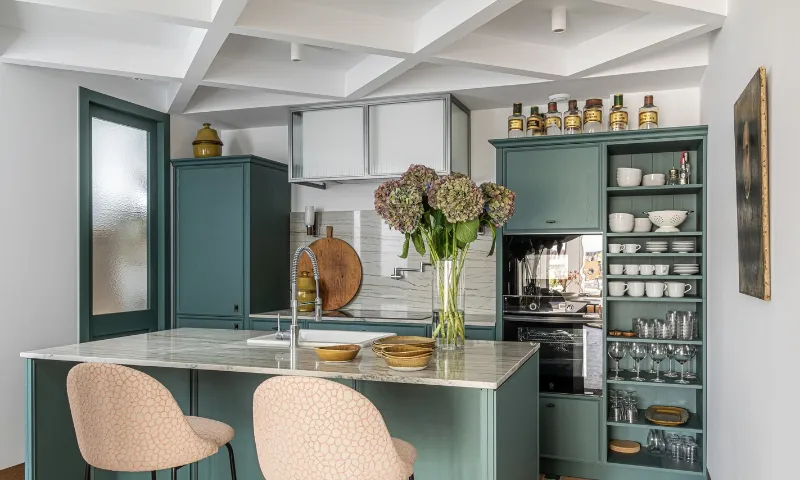
An apartment filled with light by Las letras | Luminaire SVEN
Task lighting in kitchens
The countertop, sink and cooking area are critical zones where lighting must be precise, powerful and safe. Functional kitchen lighting is essential to prevent accidents and ensure comfortable working conditions.
- Lighting must be sufficient and uniform
- A high CRI is essential for accurate colour rendering
- Neutral or slightly cool light is recommended (3000–4000K)
Effective planning should be based on a detailed analysis of workflows and furniture layout, avoiding generic lighting solutions.
In these areas, the use of halogen lamps is not recommended due to their high energy consumption and heat emission.
Work area with wall cabinets
When wall cabinets are installed above the countertop, shadows are often cast onto the work surface.
The most efficient solution is the installation of continuous LED strips beneath upper cabinets, ensuring uniform illumination across the entire worktop.
It is recommended to use strips with an opal diffuser and high-density LEDs, with an approximate power of 10W/m and colour temperatures between 2700K and 3000K.
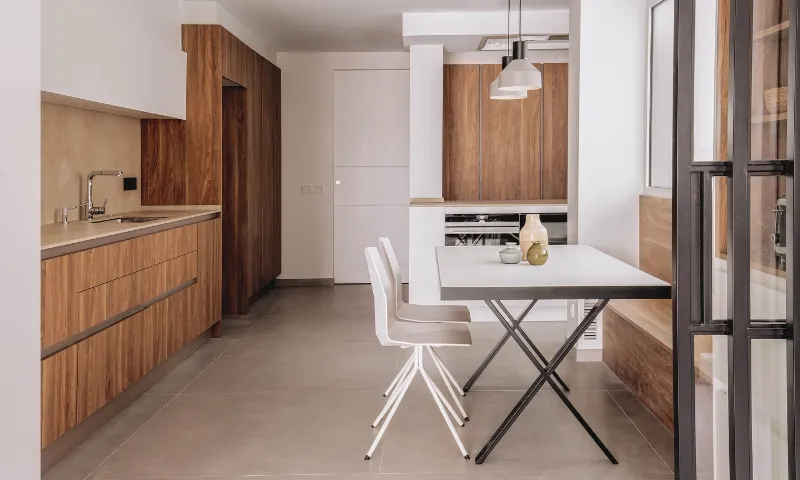
Tres torres by David Labori | Luminaire KOMBO
Work area without wall cabinets
In kitchens without upper cabinets, lighting should be installed on the ceiling, positioning the luminaires in front of the user to avoid casting shadows.
In this case, luminaires with a power of 5W–8W, a luminous flux of 500 lumens and narrower beam angles between 15° and 30° are recommended.
Lighting for the kitchen dining area
The dining or office area is a hybrid space between work and leisure. Its lighting should be warmer and more comfortable than that of functional areas.
A colour temperature of around 3000K is recommended to provide warmth without compromising visibility.
Lighting for kitchen islands and bars
In kitchens with an island or bar, linear pendant luminaires are an effective and aesthetic solution, particularly in spaces with ceilings higher than 2.5 metres.
In addition to providing correct illumination, they act as a key compositional element within the project.
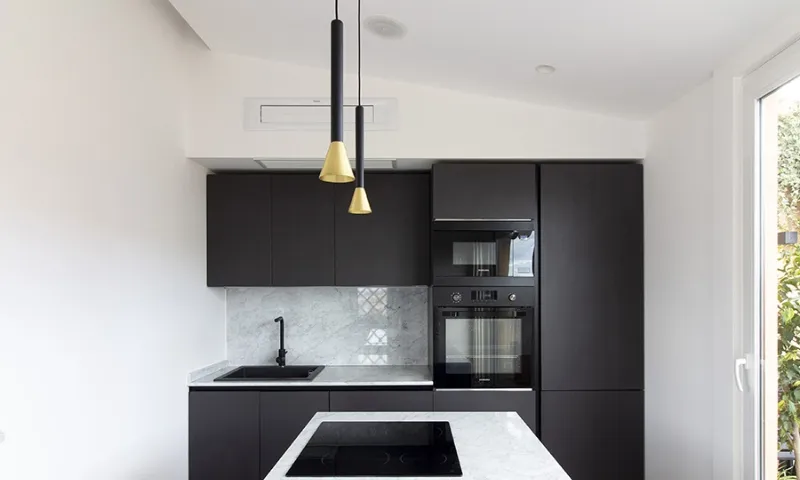
Rooftop Boutique Rooms | Luminaire DANKA
Lighting for storage areas
Accent lighting in storage areas adds both functionality and aesthetic value to the overall space.
Shelves, plinths and upper areas
LED strips or small luminaires enhance spatial perception and reinforce the general lighting scheme.
Drawers
Interior drawer lighting improves usability, especially in low-light conditions. Adhesive LED strips are an efficient and discreet solution.
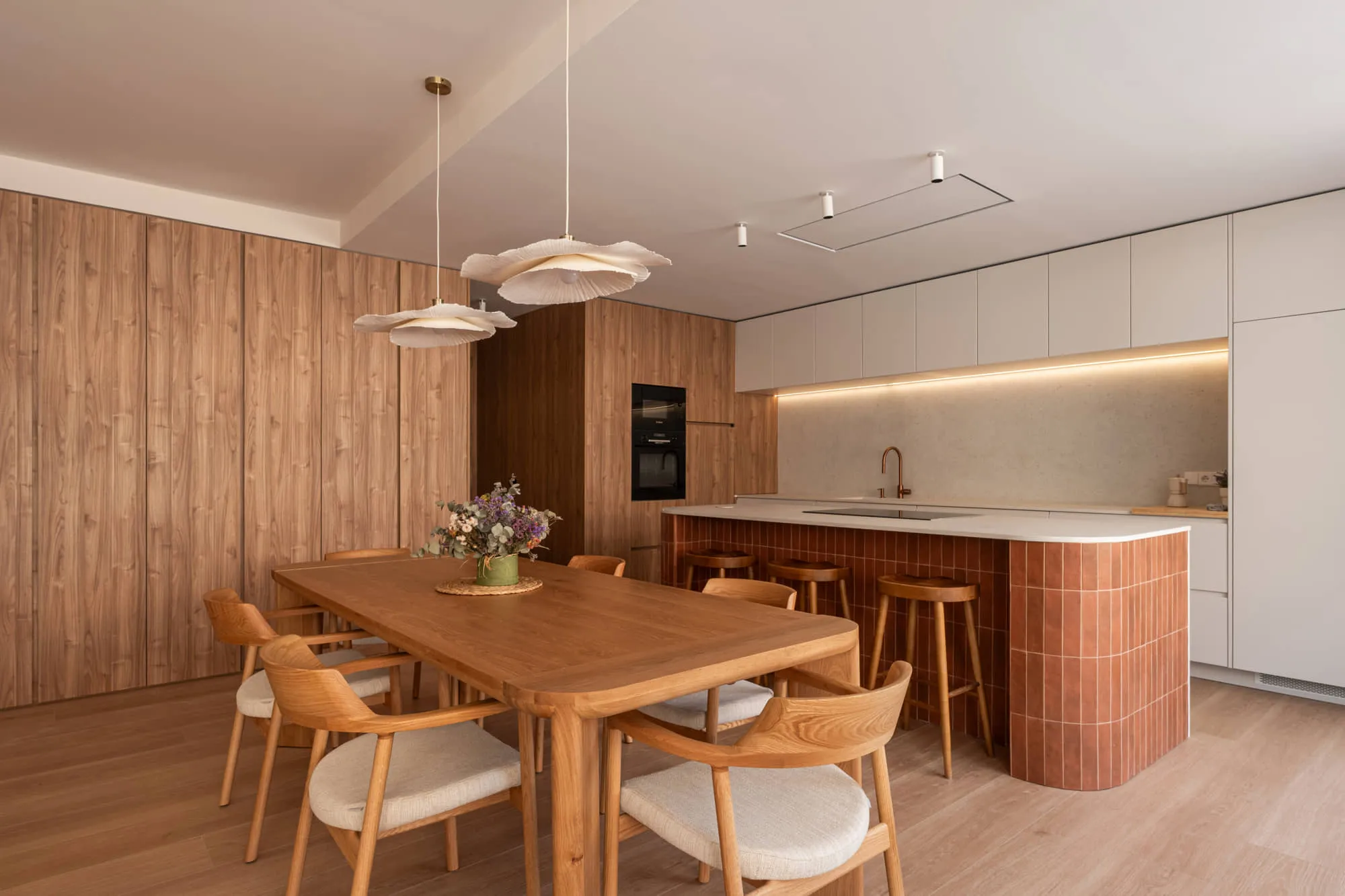
Project Terracota PI Arquitectura | Luminaire Fost
Professional tips for kitchen lighting
- Homogeneity and uniformity
- Zone-based lighting design
- Avoid shadows
- High CRI and appropriate colour temperature
- Power adapted to natural light conditions
- Use of efficient LED technology
- Careful attention to overall aesthetics
Do you need professional advice on kitchen lighting? At Faro Barcelona, we support architects and interior designers throughout every stage of the project. Contact our team and let’s design the ideal lighting solution together.
