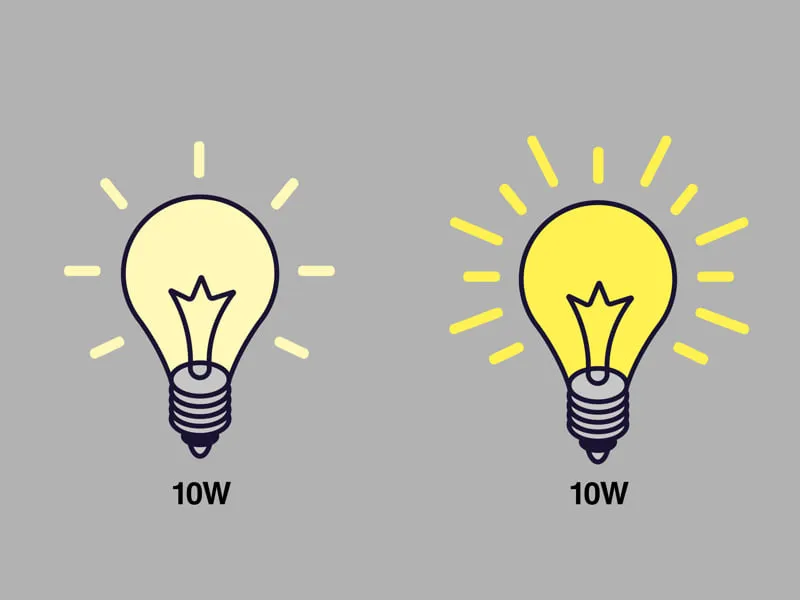
You have probably wondered why two luminaires of the same power have different light output. As a general rule, when we choose a light source we usually focus our attention on lighting parameters such as power, luminous flux or color temperature.
However, there are other factors that, although less well known, are of vital importance for our lighting approach, such as luminous efficacy.

Differences between luminous efficacy and luminous efficiency
There is still a lot of confusion and controversy about two similar but very different terms: luminous efficacy and luminous efficiency.
Erroneously and due to this subtle difference difficult to appreciate, nowadays both terms are used interchangeably to refer to the relationship between luminous flux and power. From FARO Barcelona we explain both concepts to help you understand their differences.

What is luminous efficacy
To be precise, luminous efficacy establishes the direct relationship between the luminous flux generated by a light source and the electrical power consumed.
What is luminous efficacy
However, luminous efficacy relates the luminous flux produced by a light source and the actual luminous flux emitted, i.e. how much light a light source is capable of producing and how much light it actually emits.

How is luminous efficacy measured?
Just as there are units of value defined by the ratio between different types of measurement, such as kilometers per hour or beats per second, luminous efficacy is measured from the ratio that exists between the luminous flux emitted in the form of luminous radiation and the electrical power consumed. Therefore:
Luminous efficacy (lm/W) = Luminous flux (lm)/Power consumed(W)
Ƞ= F/P= (lm/W)
As an example, let's imagine a light source emitting 500 lumens with 10W of power. In that case the luminous efficacy would be 50 lumens per watt, the result of dividing five hundred by ten.
On the other hand we have another bulb of 10W and that has the capacity to emit 1000 lumens, in this case its efficiency will be 100 lumens per watt and therefore much more convenient than the first one, since we will have more luminosity with the same consumed power.
What factors influence luminous efficiency?
As we have already mentioned, luminous efficiency goes beyond the relationship between luminous flux and power consumption. Its value is expressed as a percentage and the following factors are taken into account to establish an evaluation:
Internal temperature of the system
The lower the operating temperature of the light source, the better the efficiency of the luminaire. This aspect is very important and is determined by the quality and shape of the heat sink as well as the location and ventilation capacity of the heat sink.
Optical components
The reflectors and optics of a luminaire absorb and redirect the direction of the emitted lumens. They can therefore reduce the amount of light output from the luminaire.
Diffusers
Depending on the material and type of finish, diffusers can significantly vary the percentage of luminous flux affecting the overall efficiency of the system.
CRI
The higher the color rendering index of a luminaire, the lower its luminous efficiency.

Color temperature
Warm color temperatures reduce luminous efficacy to a greater extent than cooler ones. This is because the former need more compounds to achieve the desired degrees Kelvin.
Luminous efficacy and luminous efficiency today
LED technology has established itself as one of the most efficient systems, far outperforming incandescent, fluorescent and energy-saving lamps.
Since its commercialization in 1996, the evolution of its performance has grown exponentially from 5 lm/W to well over 150 lm/W today. The same is true for luminous efficiency, where we already find values close to 40%.
It is important to note that the theoretical maximum value is 687 lm/W and corresponds to a monochromatic light of 555 nanometers wavelength (green), a figure that in practice we cannot reach due to heat losses and the factors mentioned above.
What factor should I use as a comparative reference?
Although they are equally valid terms, luminous efficacy is an easier value to find in a technical data sheet or documentation of a luminaire and therefore, it will be more useful as a reference to compare two or more light sources.
On the other hand, as luminous efficacy is a more complex and necessary parameter to calculate, it may be less practical and less indicative in our day-to-day work.