

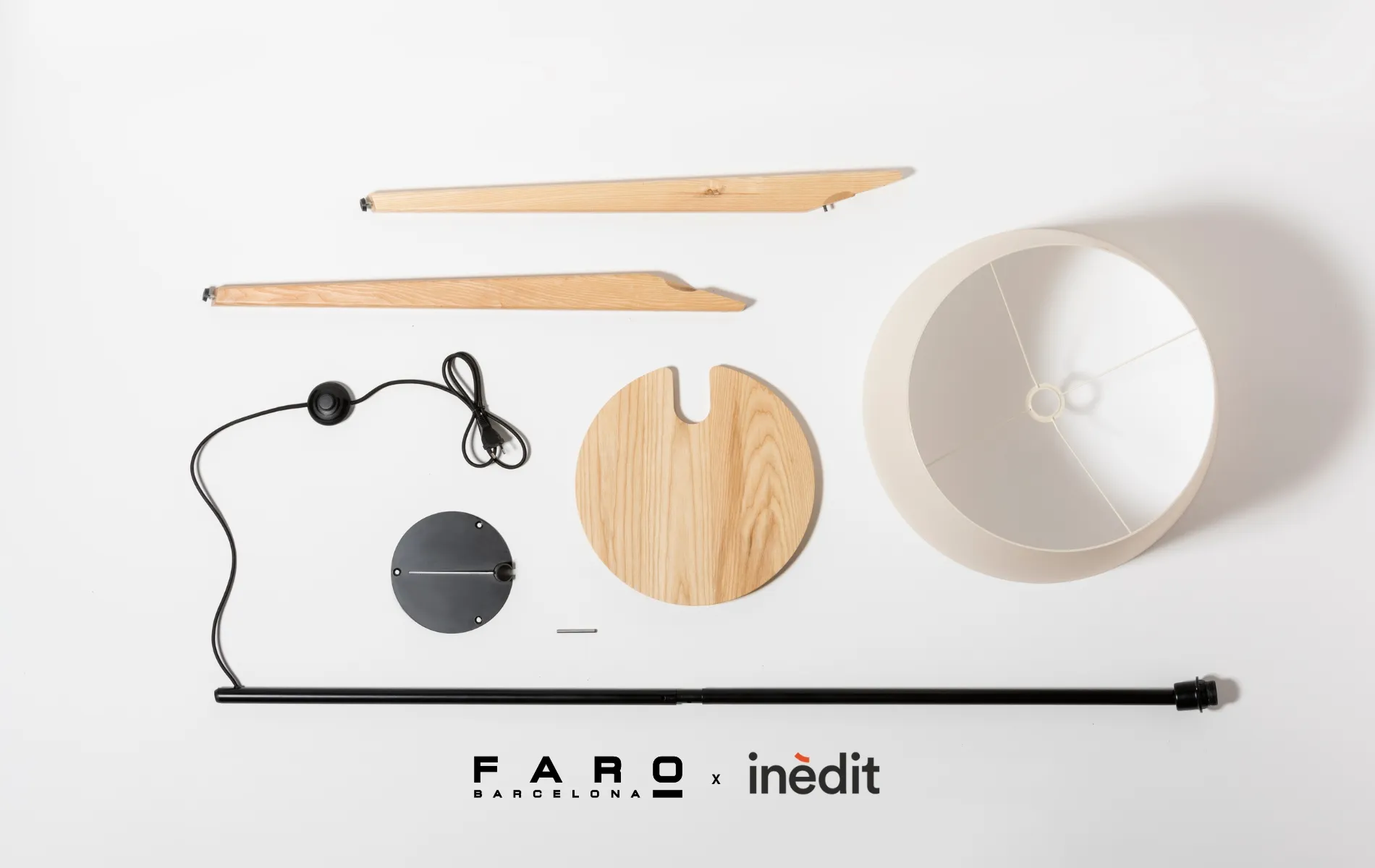
We’re taking another step forward in our commitment to responsible design and sustainability.
Hand in hand with the team at Inèdit—experts in ecodesign and sustainability—we’ve developed a custom tool for Faro Barcelona that allows us to analyse the life cycle of each of our products, accurately measuring their real environmental impact.
This way, we get a personalised carbon footprint for every product, helping us improve their design through decisions grounded in real, verified data.
What is Life Cycle Assessment or LCA?
LCA enables us to evaluate the environmental impact of a product throughout its entire life cycle: from raw material extraction to end-of-life. And we do it following the highest standards—applying ISO 14040, using the specific rules for lighting products and working with the Ecoinvent v3.9 database, a global benchmark in sustainability.
These certifications will allow us to obtain Environmental Product Declarations (commonly known as EPDs) through PEP Ecopassport, an international program specifically for electrical and lighting products. This verification adds another layer to our process, ensuring that the data generated by our new tool is reliable, comparable and market-recognised.
You can check all our Environmental Product Declarations verified by PEP Ecopassport here.
What’s the purpose of LCA?
The results are broken down into each stage of the product’s life cycle: materials, transport, industrial processes, use and end-of-life. This helps us understand in detail where the greatest impacts occur. With this knowledge, we can make more informed decisions at every stage of design and development, from selecting suppliers and materials to optimising manufacturing and distribution processes.
And above all, it helps us move toward a circular economy model where every product is designed to last and to leave the smallest footprint possible.
More transparency, more value
Having this kind of verified technical information strengthens our commitment to honest, sustainable design and gets us ready for the future regulations of our industry.
Because designing with awareness also means being transparent—and communicating the impact of what we do. That’s the direction we want to keep moving in: measure to improve.
